
Three Great Books About Meaningful Work
Unusually inspiring stories of self-discovery in the workplace

Life’s biggest questions rarely have straightforward answers. There’s not a quick bullet-point response to something like, “What makes life worth living?”
Instead, these questions tend to find their answers in narratives. The only real way we can organize and understand our lives is through telling stories. Arguments and facts aren’t enough.
Today, I want to talk about a few of the books that have helped me think about work, life, and fulfillment. These aren’t works of philosophy, psychology, or anything of the sort. Instead, it’s two novels and one work of history. These aren’t books that provide direct answers. They show the human details of the search for meaningful work.
All of them have been useful to me in some way. I hope they’re useful to you as well.
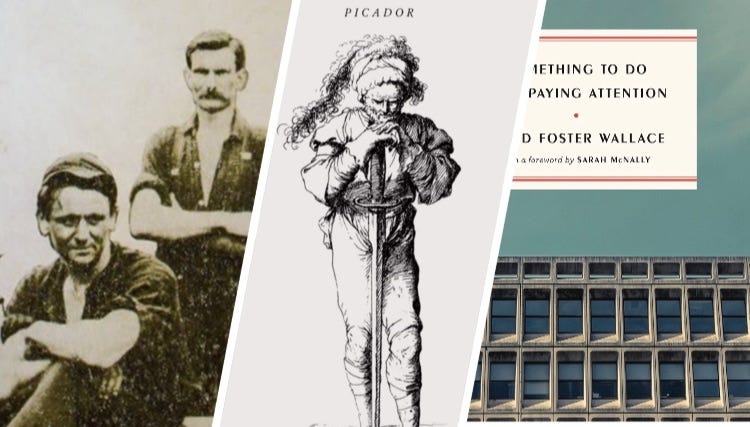
Something To Do With Paying Attention by David Foster Wallace

There’s a paradox you might notice about accounting: We often treat it as the default miserable career, something so dull and pointless that nobody can stand it. Yet it’s not hard to find happy, fulfilled accountants.1 Why is this?
Maybe it’s just because accounting is a respectable, well-paid field. That might be all we need from work. But Wallace’s Something To Do With Paying Attention has a different question: Whether accounting can be a genuine calling.
Wallace’s nameless protagonist2 tells the story of how he was once a directionless burnout. He kept dropping out of college but returned when he realized he had nothing better to do. He’s a cynic, often mocking his religious peers and his mother’s idealistic progressivism (both of which seem to him to be irrational, emotional experiences wrapped up in philosophy).
Yet through a semi-miraculous encounter with the vocation of accounting, Wallace’s hero finally finds direction in devoting himself to accounting. After a great deal of personal tragedy, uncertainty, and loneliness, he finds something to live for: The IRS.
Is he misled? Is he deluding himself? Or has he found something worth living for? It’s a profound story that you’ll think about long after you’ve finished.
This novella is a quick, accessible read—just 136 pages—that offers a compelling look into work, devotion, and finding your calling. Wallace isn’t the simplest writer in the world, but Something To Do With Paying Attention showcases the best of his talents in a quick, contained narrative.
The Faithful Executioner by Thomas Harrington
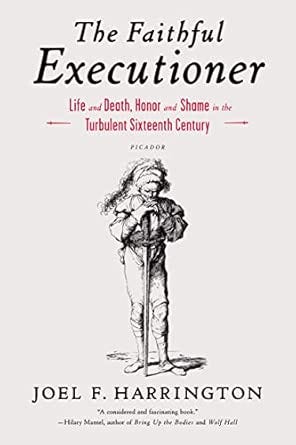
This is one of my favorite pieces of history—in fact, I loved it so much that I already wrote an entire article on its themes of vocation. Harrington presents something of a biography of Franz Schmidt, Nuremberg’s executioner from 1578 to 1617, based on Franz’s diary detailing each of the executions he carried out.
Franz did not choose this life for himself: His father was forced to become an executioner, ruining his family’s good name and leaving his son no other choices.
Despite the dishonor, Franz worked to be as respectable of a man as an executioner could be. He worked to master his craft, treated the condemned with dignity, and slowly worked to restore honorable status to his family.
To me, Franz’s story offers insight into a difficult question: Can we find meaning in any line of work, no matter how horrible, if we work with devotion and dignity? Neither Franz nor his society consider his work to be particularly respectable—while he still dutifully carries out the expected punishments, he dreams of life for himself and his sons as doctors and healers. Yet is there something to admire in his constancy and duty despite all the horrors?
The Faithful Executioner offers a fascinating look into life within a society that seems so similar to ours yet so strange. Despite the strange social mores of medieval Germany, Franz’s lifelong journey for respect and honor still feels identifiable for a modern reader.
Out of This Furnace by Thomas Bell
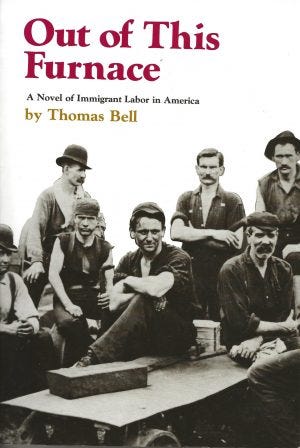
This book is near to my heart: It’s the story of Slovak immigrants coming to work in the steel mills in Braddock, a borough just outside of Pittsburgh and just across the river from my grandparents in Homestead. (I’ve written a bit about the strength of Homestead steelworkers.)
Bell tells the stories of three generations coming to America, establishing themselves, and facing tragedy and sorrow in the mills. The men and women of the mill towns sacrifice everything in pursuit of a better life—often, the die with their efforts seemingly meaning nothing. Still, they carry on, leaning on each other to create a new culture and fight for a better world for the generations to come.
Much of the novel revolves around the struggle to create dignified working conditions in the mill. As workers die in horrible accidents and their families suffer in poverty, they must ask whether the mills’ owners and managers even see them as human.
Yet just as important as the fight for physical well-being is the struggle to show the beauty and humanity of work in the mills. Characters speak poetically about the heroism and beauty of work in the mills. Bell takes his time talking about the beauty of the great masses of molten metal and the men who wrestle with it. For as much sorrow as the mill brings, it also offers a genuine sense of meaning and purpose to so many workers.
Out of This Furnace is a beautiful ode to the men and women who transformed this country, reminding us just how much of the human soul goes into our work.
These are, I hope, a few unexpected additions to your reading list. A diverse questions demands diverse answers. We can find clues everywhere from psychology to neuroscience to philosophy to poetry. I hope an unusual turn towards history or fiction may be profitable.
And, of course, it would be remiss of me not to mention our book, From Work to Vocation, discussing many of the themes we cover in these articles. You can order that here.
If you want more recommendations like this, subscribe for free (or upgrade to paid to support us and get a copy of our book sent to you).
Or share this article with someone who needs to read more.
For what it’s worth, I’ve tried to defend accounting more than once—my favorite being when I talked about competitive spreadsheeting.
Something To Do With Paying Attention is an excerpt from Wallace’s unfinished final novel The Pale King. In that novel, STDWPA’s narrator is named as Chris Fogle.