
Three Lessons From a Fisherman
Some morals from a story about work, meaning, and life


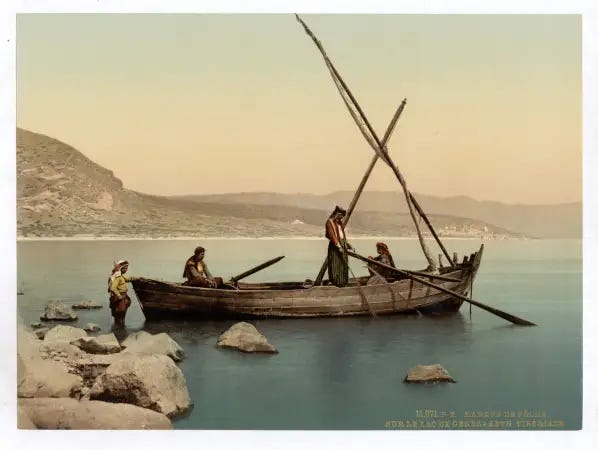
One of the best explanations of the meaning of work I’ve ever heard came from a short story. It’s one that you might have heard before: It’s about a conversation between a businessman and a fisherman.
The German writer Heinrich Böll first wrote the story, though it’s since been retold many times. With how often it’s been translated, adapted, and adjusted, the story’s almost become a standard fable—many people have heard it without even realizing who created it.
Often, stories offer us the clearest answers to life's problems. We understand our lives in stories—unsurprisingly, we often answer the biggest questions of our lives through stories as well. With that in mind, let’s see what we can learn from this narrative.
The Fisherman’s Story
The story goes like this: A businessman is on vacation, visiting an unnamed harbor somewhere. (In the original story, it’s somewhere in Europe; many retellings have changed it to South America.) There, he sees a fisherman relaxing by his boat. Although it’s a perfect time to fish, the fisherman seems to have no interest in working.
The businessman asks the fisherman why he’s not working. He tells the businessman that he had such a great catch that morning that he could end his work early. With this time, he’s decided to simply sit on the dock and enjoy the weather. He doesn’t see a clear reason why he needs to go back to work.
However, the businessman disagrees. If the fisherman worked more, he says, he could get much more fish than he needs and sell it to make a sizable profit. All of this value is wasted when the fisherman rests.
The fisherman nods and asks what he could do with his profits.
The businessman suggests he could reinvest it. With the money, he could buy all sorts of new tools for better fishing. If he bought a bigger boat, he could go out deeper into the ocean and find more fish. If he bought industrial rods, he could catch more fish and quicker.
The fisherman nods. What would happen then, he asks?
The businessman says that then, he could invest in a huge freezer to preserve his fish and export them abroad. He could build his own plant to process the fish and keep all the profits. Slowly, he could build his own small fishing empire.
The fisherman nods but asks again: What would happen next?
Soon, the businessman says, he could hire out a whole fleet of boats to go fishing. He could have drones and helicopters around to track the biggest schools of fish and find the best places to send the boats. Everything would be perfectly efficient.
The fisherman agrees: It would be the most profitable way to fish. But, he asks, what would he do?
The businessman tells him that he could do whatever he wants. He’d have all the time and money in the world. He could sit around without a care in the world and just enjoy the day.
The fisherman tells the businessman that he was already doing that.
Not knowing how to respond, the businessman goes away (depending on the version of the story, he might feel mad, jealous, or sad), and the fisherman returns to his same routine.
This story certainly resonates with us today. There’s a reason it’s become so popular as a sort of parable: In a very fast-paced world, it’s a quick example of how we can step back and reexamine just how it is that we approach our work and purpose in life.
What exactly are the lessons this story has for us? What can we learn about work, meaning, and happiness from looking at this little conversation between two very different workers?
Is Laziness A Virtue?
It’s easy to read the story as a celebration of a sort of laziness. Böll himself might have agreed: He originally titled the story “An Anecdote About Lowering the Work Ethic.” One simple way to read the story is as a mockery of the hard-working businessman and praise of the shiftless fisherman. In this sense, it’s simply a satire on hard work.
But this reading doesn’t seem to capture the whole picture. It’s true that the story shows the fisherman to be in the right and the businessman in the wrong. But the fisherman doesn’t really seem to be lazy. It’s true that he isn’t working as much as he can, but he’s not slacking off and ignoring what he needs to do.
In one sense, the story is a challenge to a misconception about hard work. When we think of hard workers, we might think of people going far above and beyond usual expectations. We might think of making work a purpose on its own.
The fisherman doesn’t fit this definition of hard work. But is he not a hard worker? He’s still clearly excellent at his job and willing to put in all the effort needed. There’s no evidence that he’s a slacker at his job.
When we read this story, we shouldn’t assume that it’s an argument between a hard worker and a lazy man. Instead, it’s a story about understanding the purpose of work.
Which Character’s Life is Meaningful?
We might associate the fisherman’s perceived laziness with a sense of purposelessness. He’s not working for anything. He’s simply lazing around staring at the sun.
He seems to be altogether directionless. He’s not spending his time working towards a particular goal. Does this mean that his life is more or less purposeless? If all he’s doing is resting in the sun, is there any meaning to his life?
To the contrary, it’s clear that he has a greater understanding of the meaning of work than the businessman. His work has a clear goal in mind: He works so he can support himself and earn this kind of rest. Is his work purposeless? No: There’s a clear goal in mind.
In fact, it’s clear that it’s the businessman who struggles to understand meaning. When we look at the businessman’s idea of work, it’s ultimately purposeless. When he looks at work, all he can see is the potential for more and more work. In the businessman’s eye, the fisherman should spend more time at work just to spend more and more time at work.
What’s the end goal for the businessman? Even he’s not sure. All he can say is that the fisherman can do whatever he’d want. There’s not a real reason for the businessman’s idea of work.
We need to reassess how we look at this kind of work. We shouldn’t see our time not working as purposeless time, and we shouldn’t see a life spent away from work as a meaningless life. The fisherman has a clear vision of what his life is for: He is meant to live fully and appreciate the beauty of the world, and he uses work as a path to this.
This is meaningful work: Work that is done with a clear goal in mind and a clear path to achieving it. Hard work isn’t good just because it’s difficult. It’s good because it leads to something good.
It’s easy to misunderstand what makes life successful. If we don’t value the right things, we can easily come to waste our time chasing after a wrong idea of success.
What Is A Successful Life?
The businessman offers the fisherman a very standard idea of a successful life: He tells him that he could be rich, powerful, and prestigious if he just accepts this advice. Everything that people are supposed to want from life could be his.
But, the fisherman says, everything that he could want from life is already his. He doesn’t need to uproot his life to look for this idea of success. He already has it.
The businessman sees success as this wealth and power that he points to. But, by the end of the story, he seems to understand that he’s missing something. Or, more accurately, he’s forgotten something.
What’s the point of all this success? With every new investment he suggests, the fisherman always asks, “But why?” In the end, after all the whys, the businessman finally says the real point of all this: If the fisherman has this kind of success, he could lead exactly the life he wants.
But, of course, he’s been distracted by these other ideas of success. He’s concerned about money and influence and so on. He’s forgotten one very important fact: Those things are only worthwhile because of the good they can bring to people’s lives. They are not good for their own sake. When we forget this, they become meaningless.
In the end, all of these things only have meaning when we think about how they can serve the human good. What’s the point of having all that “success” that the businessman is after if he doesn’t have a clear sense of how it will benefit him? What’s the point of spending all that time building a business empire if he could’ve found what he was looking for with much simpler work?
When we’re trying to find goals and benchmarks for life, we have to remember this: What we do is only meaningful if it’s done for the good of a person, whether that be yourself or another. We need to remember that what makes these things good is always how they help people lead a good life.
When we read this story, we shouldn’t think that it means work is bad, life shouldn’t be meaningful, or success is pointless. Instead, it’s asking us to reevaluate what all of these things mean. We don’t need to give up on work or quit on these goals. We simply need to learn what really makes them fulfilling.
It seems that it is prudent to learn to distinguish between someone who has no goals and someone who has achieved their goals. The notion of growth for the sake of growth also reminds me of a theme I picked up on in Dune - the utter pointlessness of seeking power for power's sake. Everyone desires to be emperor, but no one ever takes the time to spell out *why* - it is just the thing that is done.
This to say that power and wealth can be worthwhile pursuits, but, as you say, they are means to an end. A greater amount of wealth could allow one to see far-flung family and friends, or create a group with resources to solve a problem, or improve the lives of one's community. But it should always be done with specifics in mind - even if the specific is "it might be nice to have the resources on hand this offers someday" (with prudence, saving up and being prepared, not taken to the extent of miserly greed) - lest the pursuit becomes its own goal and we fall into the trap of making big number go up.
I’ve heard this story in the form of a joke, albeit a more melancholy/thoughtful one. It’s always stuck with me